
Spring Forward: Nutrition & Movement Ideas to Support Your Mental Health
Oversubscribed Newsletter
Season: Q2 2026
Spring Energy
Article by Adriana Jodoin, PsyD
For many Northeast residents, this winter was a doozy between below freezing temperatures, nor’easters, and a bomb cyclone blizzard. It was challenging enough to leave the house, let alone take care of our physical health! I have found a new sense of motivation with the changing of the seasons to make some healthy habits. For example, now that the sun sets later, I feel much more motivated to get out of the house and drive to an evening yoga class rather than get in pajamas and cozy up with my dog. Spring is a time of renewal and fresh starts, longer and warmer days, and an increased sense of joy and optimism. Let’s use this rejuvenating energy to work on the basics that we likely neglected during our winter hibernation.
The association between physical health and mental health has been well-established in the literature and there are multiple culprits for this association, such as systemic inflammation in the body and lifestyle factors, like smoking, drinking alcohol, physical inactivity, diet, and sleep (Hanna et al., 2024). We will focus on modifiable factors in this article. However it is worth mentioning that some of the explanations for increased mental and physical health concerns could be challenging to modify (e.g., socioeconomic status), and uncontrollable (e.g., childhood trauma; American Psychological Association, 2019; Luby et al., 2017).
Researchers and clinicians agree that reduction of systemic inflammation through lifestyle factors can alleviate some of the mental and physical health concerns seen in the general public. This includes an increased focus on diet, exercise, weight management, smoking cessation, and increasing omega-3 fatty acids through supplementation or eating fish (Mensah et al., 2026). I will discuss diet and exercise as areas of focus this spring season. Obviously, these changes may feel overwhelming for busy working parents. However, you do not have to overhaul your diet or exercise routine. Small changes over time will add up to meaningful results.
Diet:
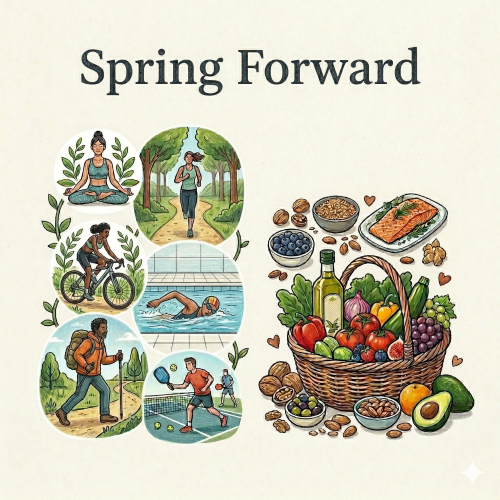
Research suggests that diet impacts physical and mental health pathways for better or for worse. The most researched and supported diet for mental and physical health is the Mediterranean diet, which mostly comprises fruit, vegetables, nuts, and seeds. It also includes a moderate amount of dairy products, low to moderate amount of fish and poultry, and low amount of red meat (Kabthymer et al., 2025). Research suggests that this diet helps prevent and reduce symptoms of depression (Bayes et al., 2022; Zuliani et al., 2026) prevent cardiovascular disease and reduce cardiovascular events (Estruch et al., 2018; Volpe et al., 2026) prevent cognitive decline and dementia (Zuliani et al., 2026), and reduce all-cause mortality in the general public (Nucci et al., 2026). The list continues on and on.
Here are some ingredients from the Mediterranean diet to incorporate more frequently:
Extra-virgin olive oil
Fresh fruit
Fresh vegetables
Tree nuts (e.g., walnuts, almonds)
Whole grains (e.g., whole grain bread, brown rice)
Legumes (e.g., chickpeas, lentils)
Fish (e.g., fish with high omega-3 fatty acids, such as salmon)
White meat (e.g., poultry)
Eggs
Specifically, eating adequate amounts of protein has been shown to reduce the risk of depressive symptoms and the more protein you eat, the lower depression and anxiety rates are (Fotouhi Ardakani et al., 2026; Ghosn et al., 2025). Low protein intake is also associated with a 1.6x to 3.2x higher risk of depression (Oh et al., 2020). The building blocks of protein, amino acids, comprise our serotonin, dopamine, and norepinephrine neurotransmitters, which are responsible for mood and wellbeing. Some of these amino acids are only accessible through our diet, so it is crucial we eat enough (He & Wu, 2020).
The recommended amount of protein is 1.2-1.6 grams of protein per kilogram of weight per day (Mozaffarian, 2026). This translates to:
Average American woman is about 77kg: 92-123 grams of protein daily
Average American man is about 90kg: 108-144 grams of protein daily
I aim to eat about 100 grams of protein per day and I try to make protein the focus of my meals. My main protein sources include greek yogurt, cheese, eggs, hemp seeds, black beans, chicken, ground turkey, ground beef, and salmon. If you want to focus on a simple change, adding nuts to your shopping list will make it more likely that you’ll grab a handful of protein mid-day.
Exercise:
Research supports that exercise reduces low grade inflammation in the body and it produces moderate to large reductions in anxiety, depression, and psychotic symptoms (Stubbs et al., 2026). Researchers and clinicians recommend 150 minutes or more per week of moderate-intensity exercise or 75 minutes or more per week of vigorous-intensity exercise (Piercy et al., 2018). Let’s review what this could look like in practice:
Moderate-Intensity Exercise:
Brisk Walking
Light Cycling
Leisure hiking
Water aerobics
Swimming laps
Vigorous-Intensity Exercise:
Running
Spin class
Basketball
Soccer
Tennis
Resistance-training is also recommended twice a week or more and should include targeting the major muscle groups, such as chest, shoulder, arms, back, abdomen, hips, and legs (Piercy et al., 2018). Examples include:
Free weights
Weight machines
Resistance bands
Bodyweight exercises (e.g., push ups, squats, lunges, planks)
I enjoy a mix of yoga classes, ballroom and latin dance classes, hiking, outdoor cycling, tennis, walking my dog, swimming, and skiing, depending on the season and weather. Specifically for working parents, adding in a post-dinner walk with the family brings connection and movement at the end of the day.
If you need some accountability partners, research suggests that supervised or group formats of exercise increase adherence, especially in those with mental health disorders (Stubbs et al., 2026). Another option is investing in a wearable device, as research shows that they increase steps by 1,800 and 40 additional minutes of walking per day (Ferguson et al., 2022). I am a big fan of the WHOOP and I have increased my step count and minutes of cardio since getting it.
If you are interested in making some of these changes and you have any medical conditions, make sure to talk with your medical provider before taking these steps.
Best of luck with making any of these changes!
-Adriana Jodoin, Psy.D.
Our guest co-writer for this article is Adriana Jodoin, PsyD. Dr. Jodoin is a licensed clinical psychologist in NY & MA. She works with kids, teens, adults, and parents in her private practice. She is also a Clinical Assistant Professor of Psychology in Psychiatry at Weill Cornell Medical College.
References
American Psychological Association. (2019). APA guidelines for psychological practice for people with low-income and economic marginalization.
Bayes, J., Schloss, J., & Sibbritt, D. (2022). The effect of a Mediterranean diet on the symptoms of depression in young males (the “AMMEND: A Mediterranean Diet in MEN with Depression” study): A randomized controlled trial. American Journal of Clinical Nutrition, 116(2), 572–580.
Estruch, R., Ros, E., Salas-Salvadó, J., Covas, M.-I., Corella, D., Arós, F., Gómez-Gracia, E., Ruiz-Gutiérrez, V., Fiol, M., Lapetra, J., Lamuela-Raventós, R. M., Serra-Majem, L., Pintó, X., Basora, J., Muñoz, M. A., Sorlí, J. V., Martínez, J. A., Fitó, M., Gea, A., & Martínez-González, M. A. (2018). Primary prevention of cardiovascular disease with a Mediterranean diet supplemented with extra-virgin olive oil or nuts. New England Journal of Medicine, 378, e34.
Ferguson, T., Olds, T., Curtis, R., Blake, H., Crozier, A. J., Dankiw, K., Dumuid, D., Kasai, D., O’Connor, E., Virgara, R., & Maher, C. (2022). Effectiveness of wearable activity trackers to increase physical activity and improve health: A systematic review of systematic reviews and meta-analyses. The Lancet Digital Health, 4(8), e615–e626.
Fotouhi Ardakani, A., Shirdeli, M., Khorvash, F., Hajhashemy, Z., & Askari, G. (2026). Association between total, animal, and plant protein intake and risk of depression in adults: A systematic review and dose-response meta-analysis of observational studies. Nutrition Reviews, nuaf314.
Ghosn, B., Abbasi, H., Nezhad Hajian, P., & Azadbakht, L. (2025). The association between animal-based and plant-based protein intake with sleep quality, mood, anxiety, depression and stress among elderly: A cross-sectional study. BMC Public Health, 26(1), 185.
Hanna, M. R., Caspi, A., Houts, R. M., Moffitt, T. E., & Torvik, F. A. (2024). Co-occurrence between mental disorders and physical diseases: A study of nationwide primary-care medical records. Psychological Medicine, 54(6), 1354–1363.
He, W., & Wu, G. (2020). Metabolism of amino acids in the brain and their roles in regulating food intake. In Advances in Experimental Medicine and Biology (Vol. 1265, pp. 167–185).
Kabthymer, R. H., Karimi, L., Livesay, K., Lee, M., Apostolopoulos, V., Millar, R., McKay, S., Barry, S., Niño, C. O., Fitó Colomer, M., Soultanakis, H., Conduit, R., Takac, M., Mizzi, S., Sidossis, L. S., Tierney, A., Itsiopoulos, C., Feehan, J., & de Courten, B. (2025). Effect of Mediterranean diet on mental health outcomes: A systematic review. Nutrition Research Reviews, 39, e9.
Luby, J. L., Barch, D., Whalen, D., et al. (2017). Association between early life adversity and risk for poor emotional and physical health in adolescence: A putative mechanistic neurodevelopmental pathway. JAMA Pediatrics, 171(12), 1168–1175.
Mensah, G. A., Arnold, N., Prabhu, S. D., Ridker, P. M., & Welty, F. K. (2026). Inflammation and cardiovascular disease: 2025 ACC scientific statement: A report of the American College of Cardiology. Journal of the American College of Cardiology, 87(11), 1381–1404.
Mozaffarian, D. (2026). The 2025–2030 dietary guidelines for Americans. JAMA, 335(7).
Nucci, D., Ragusa, F. S., Mazza, E., Veronese, N., Gianfredi, V., Volpe, M., Maggi, S., Onder, G., Sieber, C., Zanetti, M., Silano, M., Chernykh, A., Di Lorenzo, F., Romiti, G. F., Schirò, P., & Ungar, A. (2026). Adherence to the Mediterranean diet and all-cause mortality: A systematic review and meta-analysis within the Italian National Guidelines “La Dieta Mediterranea.” Nutrition, 147, 113189.
Oh, J., Yun, K., Chae, J.-H., & Kim, T.-S. (2020). Association between macronutrients intake and depression in the United States and South Korea. Frontiers in Psychiatry, 11, 207.
Piercy, K. L., Troiano, R. P., Ballard, R. M., Carlson, S. A., Fulton, J. E., Galuska, D. A., George, S. M., & Olson, R. D. (2018). The physical activity guidelines for Americans. JAMA, 320(19), 2020–2028.
Stubbs, B., Ma, R., Teychenne, M., et al. (2026). Integrating physical activity into routine psychiatric care: A review. JAMA Psychiatry.
Volpe, R., Ciccone, M. M., Pala, B., Barbarano, F., Camastra, S., Caprio, M., Casirati, A., Ferrera, A., Galletti, F., Greatti, A., Mollica, M. P., Paolillo, S., Parretti, D., Nucci, D., Veronese, N., Fontana, L., Maggi, S., Onder, G., Silano, M., Zanetti, M., Gianfredi, V., Ricci, M., & Volpe, M. (2026). Efficacy of Mediterranean diet for the prevention of cardiovascular disease in patients: A systematic review and meta-analysis featured in the Italian National Guidelines “La Dieta Mediterranea.” Nutrition, 142, 113053.
Zuliani, G., Gianfredi, V., Veronese, N., Volpe, M., Maggi, S., Onder, G., Silano, M., Nucci, D., Zanetti, M., Benussi, A., Burgio, M. I., Fadda, M., Guindani, P., Sollai, S., Cereda, E., & Caffarra, P. (2026). Efficacy of Mediterranean diet for the prevention of neurological diseases: A systematic review and meta-analysis featured in the Italian National Guidelines “La Dieta Mediterranea.” Nutrition, 142, 112990.