
Oversubscribed Book Club: The Let Them Theory by Mel Robbins
Oversubscribed Newsletter
Season Q1 2026
New Year, Fresh Start
Book Review by Amanda McGovern, PhD
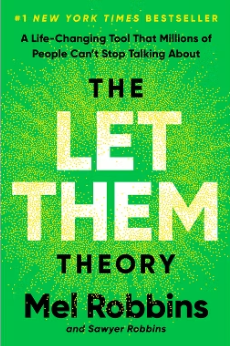
For this season, I decided to review The Let Them Theory by Mel Robbins. As a book that has received a lot of attention, I thought our readers might appreciate seeing it reviewed here. The Let Them Theory encompasses two parts: Let Them and Let Me. The premise of the Let Them Theory is accepting that you can not control others, but you can control yourself, including your thoughts, feelings, and behaviors. Let Them frees you from the burden of trying to manage other people (Let Them), which then enables you to have the energy to focus on your own life (Let Me) (Robbins, 18).
The book is divided into three sections: one in which she explains the Let Them Theory, one in which she applies the theory to different aspects of life (e.g., managing stress, fearing others’ opinions, overcoming comparison), and one in which she applies it specifically to adult relationships. One of my favorite sections was “Let Them Think Bad Thoughts About You”. I think this one will resonate with most of us. Robbins shares how when she was just starting out, she resisted posting on social media for two years. She incessantly worried about what others would think about her posts, whether people would judge her negatively, think she was arrogant, or unoriginal, or a copy-cat. She expended so much energy creating posts and then criticizing them that she never posted nor moved toward her goal. There are countless times that I have allowed others’ opinions to prevent me from moving towards my goals. Even thinking about publishing this newsletter, Megan and I worried about whether people would enjoy our articles, think they were interesting enough or engaging enough or original enough. Let Them and Let Me have been very helpful to us throughout this new endeavor.
I think the beauty about the Let Them Theory is its simplicity. Repeating Let Them signals the brain that it’s not worth stressing about something and/or someone. This pause then enables you to shift your focus to yourself (Let Me). Even though the theory is rooted in long-standing psychological approaches, including Stoicism, Emotional Detachment theory, and Buddhism, Robbins has packaged these principles in a way that we can easily apply them to our lives. I think that’s Robbins’ superpower!
However, I felt that the book was superficial, redundant, and disjointed at times. Robbins repeatedly makes the claim that her Let Them Theory is going to transform your stress level, your anxiety, your emotional reactions, your behavior, your relationships, etc. This is a HUGE claim which ignores our complexities as human beings and the many other factors that affect our stress, emotional reactions, behavior and relationships. She also claims that her theory and her ideas throughout the book are backed by “science”, “evidence”, “expert interviews”, and/or “decades of research”. Even though she includes a lengthy bibliography, she rarely attaches sources to her statements and it feels like she is not truly honoring the breadth of research and original thought underlying her words. Furthermore, I found that her redundancy caused me to lose interest at times, especially in some of her long-winded personal examples, and I had to resist the impulse to skim. Lastly, Robbins also becomes tangential in certain sections and presents a new skill or tool to use alongside the Let Them Theory. For instance, in her section about motivating other people to change, she goes on to introduce the ABC Loop (a repackaged version of motivational interviewing), which feels random and jarring.
To end, in my opinion, the value of the Let Them Theory lies in its simplicity and some may find it transformational. However, Let Me just say that it will not fix all of your problems.