
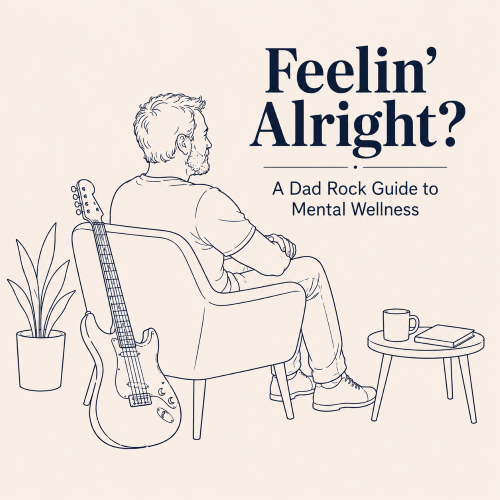
Feelin’ Alright? A Dad Rock Guide to Mental Wellness
Oversubscribed Newsletter
Season: Q3 2026
Summer Rhythms
Article by Jamie Hambrick, PhD & Tony Puliafico, PhD
When we were asked to write this piece, we were honored and also a bit stuck on how to compile helpful tips for middle-aged working dads. Let’s be clear - the plight of the working dad does not compare to the unrealistic pressures and inequities faced by working moms. And yet, middle-aged men frequently struggle with loneliness, professional dissatisfaction, the physical and mental realities of aging, and have the highest suicide rate* of any demographic. So, to speak to these concerns, we did what any middle-aged dads would do – communicate about emotions through lists and music. Specifically, we compiled a list of lyrics from some of our favorite “Dad Rock” artists to point out ways that all of us middle-aged dads can take care of ourselves and the ones we love. Here they are:
“Shout, shout, let it all out…”
Shout, Tears for Fears
“Shout” was part of the soundtrack of our 80’s youth by the highly underrated band Tears for Fears. Although the song primarily focuses on speaking out against oppression, the title line serves as a reminder to us middle-aged dads to express ourselves emotionally, to “let it all out” sometimes. Research indeed points to health benefits of emotional expression. However, the Dad-iverse is not set up for men to easily emote with loved ones and friends, as societal norms expect us to present as strong and in control. If emotional expression is challenging for you, consider a first step like sharing a vulnerable moment with a partner or discussing an emotionally evocative TV show or movie with a close friend.
“Don’t let yourself go. ‘Cause everybody cries. And everybody hurts. Sometimes.”
Everybody Hurts, R.E.M.
Not only do men have to get better at emotional expression, we have to get better at tolerating others’ emotional expression. Too often we can lock in on the fix-it mentality and struggle when our loved ones are struggling. My son came home after a recent fight with a friend and I had to remind myself to not speak from my fears and personal struggles, but just to be present and speak to the validity of his feelings. Making space for others’ feelings can make it easier for us to make space for our own. And listening and presence is 95% of the job.
”I’ve got to run to keep from hiding. And I’m bound to keep on riding. I’ve got one more silver dollar. But I’m not gonna let ‘em catch me, no. Not gonna let ‘em catch the midnight rider.”
Midnight Rider, The Allman Brothers Band
I come to you as an imperfect ambassador for the importance of sleep. I’m famously a night owl in my home, partly due to the nature of my work, and partly because being up in the quiet of the house suits my inner Midnight Rider—the part of me that needs a little uncomplicated alone time to watch garbage movies or play PS5 or just be alone with my thoughts. But I will say that when I am able to achieve some regularity in my sleep hygiene I no longer feel like I’m getting away with one more silver dollar. Better to talk with your partner about the time you need than trying to steal it after everyone is asleep—if you’re acknowledging and respecting your partner’s own Midnight Rider then it’ll probably work out better for both of you.
“You just call on me, brother, when you need a hand. We all need somebody to lean on.”
Lean on Me, Bill Withers
These words, from the incomparable Bill Withers, tap into the power of friendship and connection, particularly in tough times. It can feel awkward or weird for guys to call each other to make plans or just say hi. And yet, building and maintaining those connections is important. Research suggests that, increasingly, adult males report feeling lonely and having no or few close friends. A while back, I noticed that I was overrelying on text message group chats to stay in touch with old friends, which limited the amount of connection felt in these relationships. So I have been trying to call or meet up in person with close friends at least once every few months. It can also help to throw yourself into an activity, sport, or hobby that will bring you together with friends, acquaintances, or neighbors regularly.
“Times are hard. You’re afraid to pay the fee…I’m a fool to do your dirty work.”
Dirty Work, Steely Dan
Burnout is real. The ongoing pressures of the ever-increasing grind at work can make the idea of active participation at home feel daunting. But as sociologist Tressie McMillan Cottom has observed, many of the early activists advocating for the radicalism of self care also noted that burnout can just as often be the product of an absence of meaningful work, and let’s face it, our partners are usually going through the same thing. Effective collaboration with partners on parenting and household responsibilities can bring a sense of shared purpose and meaning if we meet them as active participants and not as one more thing we feel a lack of control over. Every Sunday I make pancakes for my boys and take pleasure in every aspect of the ritual—the setup, the preparation, finding out what they loved, throwing them curveballs with the toppings, and even the clean-up all feel like acts of love. Finding joy and meaning in that process engaged me with meal planning and cooking on other nights and seeing much more of the household management as less of a chore and more opportunities to let my family know how I feel and model for my sons the kind of men I hope they will be in their own households.
“Time to move on, time to get going. What lies ahead I have no way of knowing. But under my feet, baby, grass is growing.”
Time to Move On, Tom Petty
Does it get more Dad rock than Tom Petty? These lines from his Wildflowers album speak to two realities that we face in middle age: (1) We are thoroughly unsure of what the future holds, and (2) Time doesn’t care and moves on anyway. Getting older sucks. Being uncertain about the future is scary. But the lyrics also suggest two approaches that can help – tolerating uncertainty and practicing mindfulness. Learning to tolerate uncertainty is exactly as it sounds; it’s about acknowledging and accepting all the potential risks, failures, and losses that may come our way. When we worry, doomscroll, or seek reassurance from our partners or favorite AI bot, we are trying to get rid of uncertainty. These behaviors may give us some relief in the moment, but they don’t give us certainty. And they get in the way of our learning how to live with the unknowns in life. So, the next time you’re faced with a big question mark in life, avoid the reassurance seeking and use it as an opportunity to build your uncertainty tolerance. Mindfulness can help. When we practice mindfulness, we work to bring our full attention to the present. Essentially, we notice that, under our feet, the grass is growing. You can practice mindfulness using one of the zillion apps available online, or you can find small daily ways to connect with the present. I use my daily dog walks as a great opportunity to “lock in”, as the kids say, and attend to the sounds and sights around me.
“Swear you’ll save the world when I lose my grip. Tell me you’re in control. Swear you’ll say the word when I start to slip. You’ll be the first to know.”
“Save the World,” Jason Isbell and the 400 Unit
So much of being a modern man is balled up with the idea of all the things that men have been expected to be within societal norms—the protector, the last bulwark against the chaos, the Watcher on the Wall. The greatest transition I’ve made as a dad has been acknowledging a different kind of vulnerability—the man who could watch “Ransom” or “Battle Royale” or any movie where a child is in trouble is long gone. In a modern world of school shootings, political uncertainty, AI, climate change and an endless range of existential threats, it can be useful to remember that you’re not the first. My greatest resource has been history—remembering I grew up in an age where I hid under desks to protect myself against nuclear bombs and in fact it has been much, much worse. But we have to remember collectively always that we are not alone and find ways to build community, any way we can.
“I asked you to go to the Green Day concert. You said you never heard of them. How cool is that?”
El Scorcho, Weezer
Set aside the dissonance of not knowing who Green Day is. Another aspect of getting older can be losing track of your old interests as well as curiosity about the new. Staying curious and engaged is critical to so many markers of our physical and mental health, ranging from ameliorating the cognitive declines associated with aging, staving off depressed mood, and giving you other reasons to stay active. Did you used to go to shows a lot in college? Bring that back. Have you always wanted to try pottery? No time like the present. We’re blessed with an embarrassment of riches in New York but I come from a much more rural area where I was able to do everything from community theater to fencing with just a little curiosity and minimal financial investment. Sometimes it’s just about saying “yes” and “how cool is that?”
“My God, love is embarrassing…”
Love is Embarrassing, Olivia Rodrigo
You may not have expected to see Olivia Rodrigo on this list, but she has a massive Dad rock fanbase. They even wrote about it in the New Yorker. And though Rodrigo’s song “Love is Embarrassing” has nothing to do with middle-aged fatherhood, the line captures so much about being a present and affectionate Dad. As men, we may shy away from hugging our kids (especially our sons) or telling them that we love them. We may not have those tough conversations about dating or sex with our teenagers. We may avoid setting limits on our kids’ behavior that will stand out among their friends or their friends’ parents. Love is embarrassing. But facing the awkward and embarrassing moments with our kids models for them how to do it themselves. It also builds stronger parent-child connections and opens lines of communications. Not a bad idea, right?
Our Guest Co-Writers for this article are Jamie Hambrick, PhD & Tony Puliafico, PhD
Dr. Jamie Hambrick is an Assistant Professor and Lead Psychologist at Northwell Health, where he directs the CBT training program for psychiatry residents. He has a book about CBT for psychiatrists coming soon from Oxford University Press. Dr. Hambrick also works with teens and adults in private practice.
Dr. Tony Puliafico is a clinical psychologist specializing in child and adolescent anxiety, obsessive-compulsive disorder, and school avoidance. He serves as Director of the Columbia University Clinic for Anxiety and Related Disorders - Westchester and Associate Director of Clinical Services for the Division of Child and Adolescent Psychiatry and Developmental Sciences at Columbia University Irving Medical Center.
*If at any time you are experiencing thoughts about harming yourself or others, it is important to seek out professional support. There are excellent, effective psychotherapy and medication treatments available to help things improve. There are also a range of crisis services that are available immediately:
988 Suicide & Crisis Lifeline: 988
Crisis Text Line: Text TALK to 741741
Resources Database: SpeakingOfSuicide.com/resources