
Oversubscribed Book Club: Atomic Habits by James Clear
Oversubscribed Newsletter
Season: Q2 2026
Spring Energy
Article by Megan Hughes, PhD
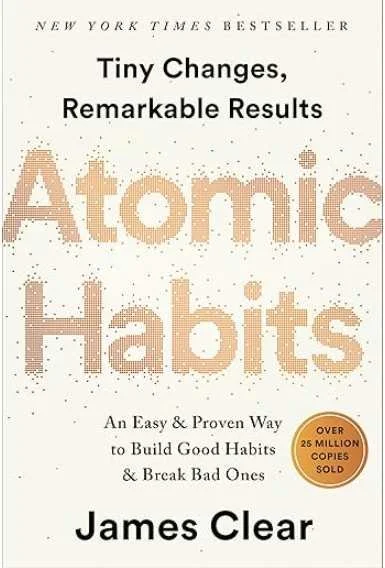
For this newsletter’s book club, I decided to dive into James Clear’s book, Atomic Habits (Clear, 2018). I know I’m late to the game, but was still excited to jump in. To really engage with his work, I first listened to the original 2018 book, Atomic Habits, and then I completed the Atomic Habits workbook, focusing on a particular habit I wanted to change. Clear takes the angle that to make big changes in life you need to change your small, regular habits. He states, “decide who you want to be, and then work backward from there, thinking about the behaviors that kind of person performs…this is the real reason why habits matter. Not because they help you achieve certain things, but because they help you become the person you wish to be” (p. 19, Clear, The Atomic Habits Workbook, 2025). As a psychologist, I regularly work with clients on making behavioral changes that are in line with their values, so his approach sounded consistent with that.
Clear presents strategies for adding in new “healthy” habits as well as cutting out ineffective habits, although he notes that adding a new habit is the easier of the two. For my experiment, I worked on adding something new, because frankly, I wanted to increase my likelihood of success.
The Atomic Habits workbook goes into great detail with exercises to set the stage, and consider your desired identity, long-term vision for yourself in all domains of life, before you start thinking about any specific thing to change. I knew my goal was to cook more dinners, and decided on the goal identity as someone who is a cook. I have never identified myself as someone who was a good or intentional cook. I lived in cities for 20 years after college and became an expert in takeout and delivery. When I did try to cook, I’d start way too late, and look around the kitchen when someone was hungry and try to figure out a plan right then. I have attacked this problem in various ways over the years, thinking that the habit I needed to develop was simply to cook more frequently. I found Clear’s discussion of “root” vs “branch” goals helpful in identifying where I was going wrong. I was trying to make a new habit every weekday at 5 PM, instead of starting with a new system at the root of the problem: meal planning and effective grocery shopping. I was targeting the branch goal of cooking, without getting at the root of the problem.
So, armed with my new aspiration of chef Megan, I started working through the active steps of Clear’s plan.
The four steps Clear teaches to change habits include:
Make it obvious (Cue)
Make it attractive (Craving)
Make it easy (Response)
Make it satisfying (Reward)
Make it Obvious: Clear has a variety of strategies to use to make the new habit obvious, so that you’ll remember to do it. For me, I added a meal planning system to my pre-existing weekly planning system. I have a whiteboard in our kitchen where I write down the family’s weekly schedule. This includes who is dropping off the kids at school, what specials they have at school that day, and what activities we have scheduled in the evening. When I’m updating the whiteboard every Sunday, I already go through a checklist of the elements I need to include on the schedule. To make my new habit obvious, I simply added an item on the checklist that says “pick meals for the week and write them on white board.” Obvious, unlocked! This was a pretty simple change for me, but of course, depending on the desired habit, it can get much more challenging. Clear has many ideas for other more complicated scenarios.
Make it attractive: This is another one that was relatively straight-forward for me. I love the world of planners and schedules, and find joy in pretty pens, paper, stickers, and washi tape. So making my meal planning process cute somehow was going to help me be excited to do it. Although Clear obviously isn’t talking about making a task literally attractive, in my case it could be that simple. For the vast majority of adults for whom stickers are no longer that enticing, Clear suggests a variety of options. He recommends creating a cozy ritual of drinking tea while doing a new task, or pairing a new habit with established habits that you already enjoy. Or, you can find the most fun version of a habit, for exercise that could be picking zumba or pickleball, or only allowing yourself to watch your favorite show when you are on the treadmill. And, my mildly embarrassing strategy is to use cute meal planning stickers (yes, they exist) when writing up my plan for the week.
Make it Easy: This was the section that I had to do the most work for. I ended up having to rework my entire system, and try multiple iterations before I found something that was workable. I really thought through the root problems that kept getting me stuck. After much trial and error, I came up with the following plan:
I first developed a list of typical weekday meals, their ingredients, and how long they took from start to finish. Then, on Sundays when writing out our upcoming week’s schedule on the whiteboard in the kitchen, I would calculate how much time I actually had for cooking each day. I could then select the meals for those days based on the time available, and write them on the whiteboard (with a pretty color marker), and write the time that I’d need to start cooking to make it all actually happen.
If there was only a 15-minute window to cook between the end of the work day and when we needed to leave for an evening activity, I would select a prepared meal from the grocery store that I just needed to heat up. If I had an hour, I could do the kids’ favorite, taco night, which required making rice (which I’ve recently accepted takes a really long time!).
After making the plan for the week, I wrote down which ingredients I needed to put on my grocery list. I have a printed grocery list of what we might typically get in a week created and printed out, in order of the aisles at our grocery store. Making a list that was already organized made it *much* more pleasant to get groceries at the store.
Lastly, I’m also now completing this process in the kitchen instead of my home office. Basically, I changed almost every step of my existing and nonfunctional system to become a step that was much easier to do. I’m guessing that practiced home cooks just naturally do all of the above steps, but for me, I needed to make it all really explicit for it to work.
Make it Satisfying: If the habit isn’t intrinsically rewarding, then you may need to add a reward to make it feel satisfying after the fact. Having already discussed my love of cute stickers, that was simple enough to add a food sticker to my weekly calendar on the nights I cooked. Again, assuming that many adults are not reinforced by stickers, Clear had lots of ideas for making challenging things more rewarding. In my example, you could reward yourself with $5 every time you cook instead of order. You’ll still be saving money by cooking at home, and you’ll collect a good amount of money to treat yourself. (Clear warns not to treat yourself with the thing you are trying to change…so in this case, I wouldn’t take my savings and use it to spend on a night out at a restaurant. But, for me, I could save up to spend on…more stickers ; )
Final Thoughts: Clear has several recommendations for each of the four steps for habit change. I’ve only mentioned the ones I incorporated into my meal planning goal, but there are many more to choose from that might apply particularly well to your specific goal. What I found especially helpful from the Atomic Habits Workbook was that it has space for me to develop elements of my new system, try it out, notice barriers, and then revise the plan to overcome that particular barrier. Clear sets the stage for this to be an ongoing process of improvement.
I sort of wanted to hate Atomic Habits and I sort of wanted to love it. I ended up being a fan of the Atomic Habits materials and recommend it for people who are trying to make a change but keep getting stuck. I do think it is important to acknowledge that much of the suggestions are not Clear’s new ideas, but rather his compilation and effective packaging of the research of social scientists like BJ Fogg, who have dedicated their careers to behavior change. James Clear might be the Mel Robbins of behavior change, but I’m not mad about it.
References:
Clear, J. (2018). Atomic habits: An easy & proven way to build good habits & break bad ones. Avery.